
What is Brand Identity and Why Does Your Startup Need It?

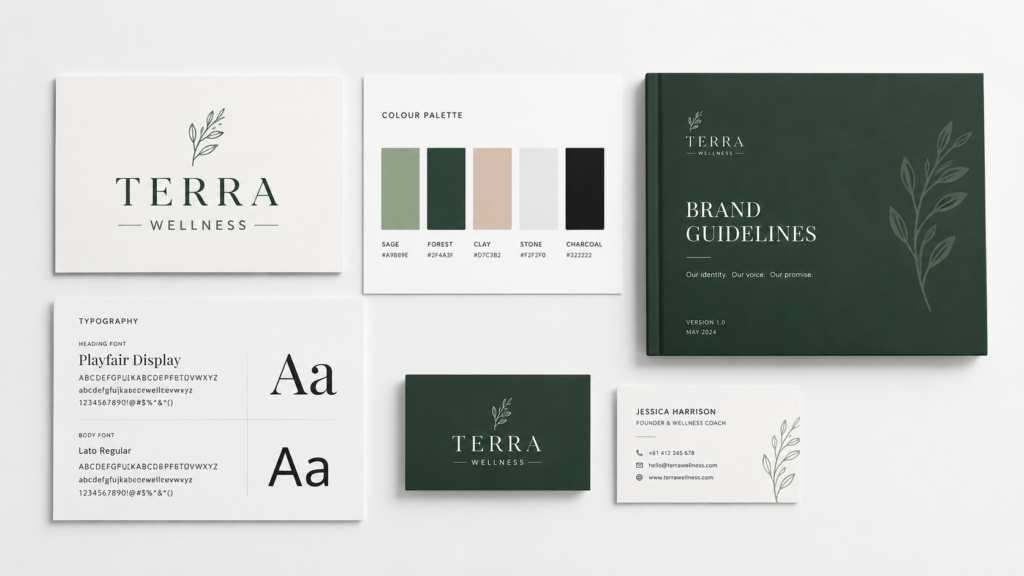
You have probably heard the phrase “brand identity” thrown around in every marketing conversation. But most founders, when asked what it actually means, say something like “our logo and colours.”
That answer is not wrong — but it is dangerously incomplete.
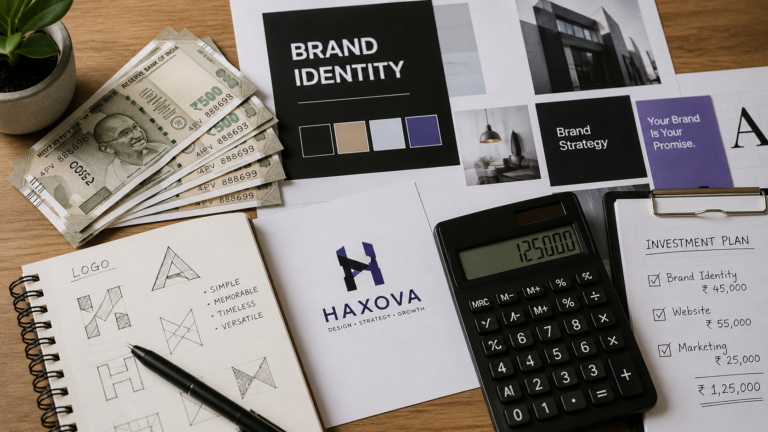
Your brand identity is the full system of visual and verbal elements that make your business recognisable, consistent, and trustworthy across every platform and every touchpoint. When built correctly, it makes customers remember you, trust you faster, and choose you over competitors who offer similar things.
This guide breaks down exactly what brand identity includes, why it matters more for startups than any other stage of business, and what happens to companies that skip it.
What Brand Identity Actually Means
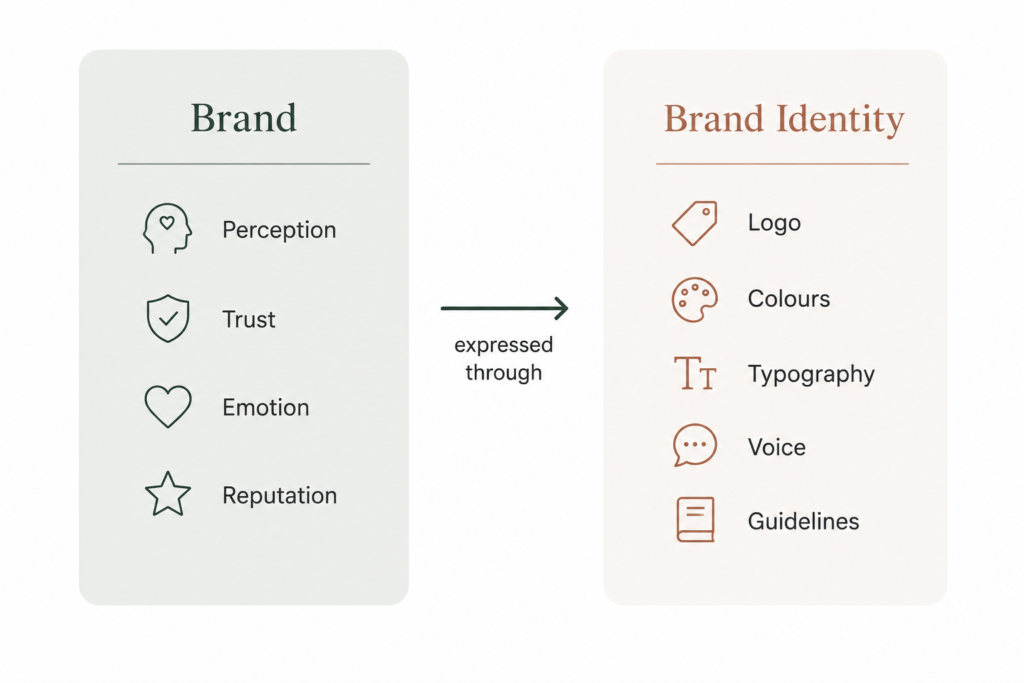
Brand identity is not your brand. It is the expression of your brand.
Your brand is the perception people have of your business — the feeling they get when they interact with you, the trust they associate with your name. Your brand identity is how you communicate that perception visually and verbally.
Think of it this way. Your brand is a person’s character — their values, personality, and reputation. Your brand identity is how that person dresses, speaks, and presents themselves to the world.
Both matter. But without a strong identity, even the best character goes unnoticed.
The 6 Components of Brand Identity
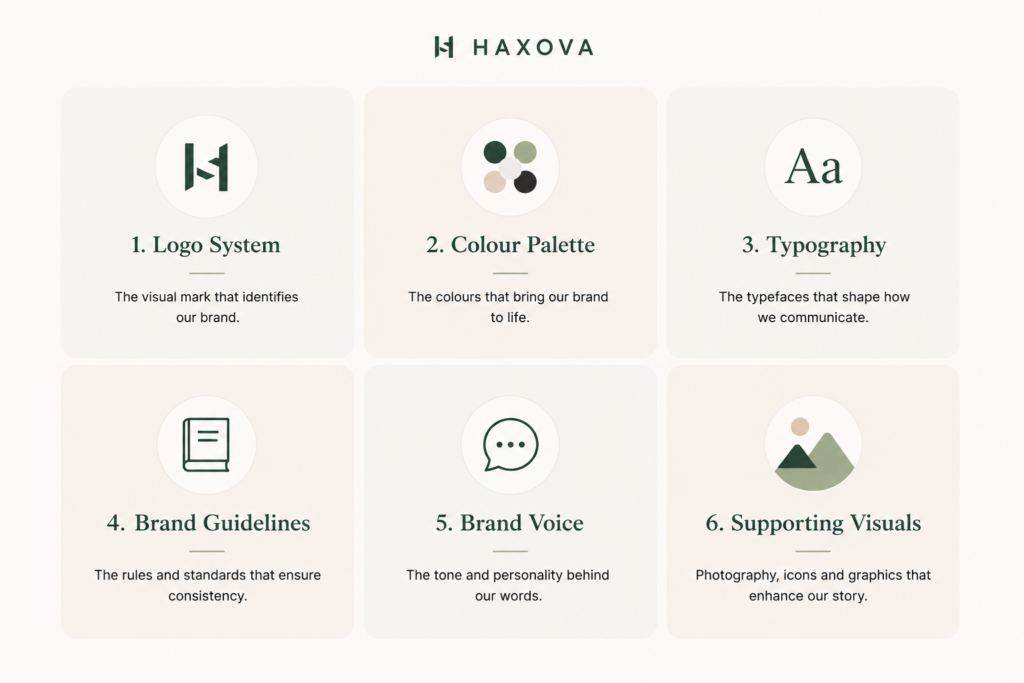
A complete brand identity is made up of six elements. Most people only think about the first one.
Component 1 — Logo System
Your logo is the visual anchor of your brand. But a professional logo is not just one file — it is a system. This includes a primary logo for your website and main brand materials, a secondary or alternate version for tighter spaces, a standalone icon or symbol for app icons and social media profile photos, and a wordmark which is your business name set in your brand typography.
You need all of these because your brand appears in very different contexts. A full logo that looks great on a website header becomes unreadable when squeezed into a circular Instagram profile picture.
Component 2 — Colour Palette
Colour is one of the most powerful tools in branding. Research consistently shows that colour increases brand recognition by up to 80 percent. But most startups pick colours they personally like rather than colours that communicate the right message to their target audience.
A professional brand palette has a primary colour used most consistently, one or two secondary colours that support the primary, neutral tones for backgrounds and body text, and an accent colour used sparingly for call-to-action elements and highlights.
Every colour must come with exact codes — HEX for digital, RGB for screen display, and CMYK for print. Without these, every vendor and team member who touches your brand will reproduce slightly different shades. Over time, this inconsistency erodes trust.
Component 3 — Typography
Your brand needs two typefaces that work together — a heading font that is distinctive and attention-grabbing for titles and key text, and a body font that is clean and highly readable for paragraphs and supporting content.
Typography does more than display words. It communicates personality. A sharp, geometric sans-serif font feels modern and confident. A warm serif font feels established and trustworthy. Your font choices should match your brand personality — not just look attractive on their own.
Component 4 — Brand Guidelines
This is the rulebook that governs how every other element is used. Brand guidelines cover how much spacing should appear around your logo, which colour combinations are approved and which are not, the correct font sizes for different uses, and what your brand should never look like.
Without brand guidelines, your brand will look different every time someone new works on it — whether that is a new team member, a social media manager, a packaging printer, or a developer. Inconsistency is one of the most common ways startups unknowingly damage their own brand.
Component 5 — Brand Voice
Brand identity is not only visual. Your brand voice is how your business communicates in words — the personality that comes through in your website copy, your Instagram captions, your email subject lines, and your proposals to clients.
When your visual identity and your verbal identity feel disconnected, customers sense it — even when they cannot explain why. A brand that looks premium but writes informally, or looks playful but communicates stiffly, creates confusion that erodes trust.
Component 6 — Supporting Visuals
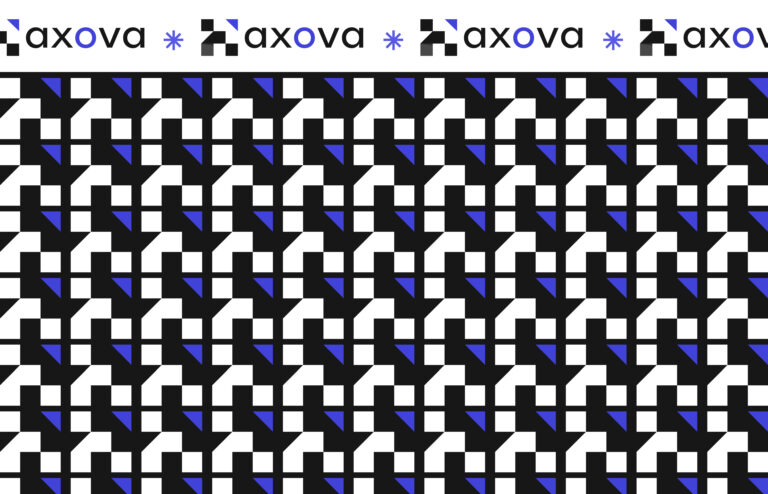
This includes photography style, illustration style, icon style, and any recurring visual patterns or textures associated with your brand. These elements ensure that even content without your logo still feels unmistakably like your brand.
Why Brand Identity Matters More for Startups
Established companies can operate with weak brand identity for years — they have reputation, customer history, and word-of-mouth carrying them. Startups have none of that.
When a potential customer encounters your startup for the first time, they make a judgement within seconds. That judgement is almost entirely based on what they see — your website, your social media, your logo. If your brand identity does not immediately signal credibility and professionalism, they leave.
Here is what a strong brand identity does for a startup specifically.
It builds trust before you have earned it. A polished, consistent brand identity makes a new business look and feel established. First-time customers cannot tell the difference between a business that launched last month and one that has been operating for three years — if the brand identity is solid.
It makes every marketing channel work better. Whether you are running Google Ads, posting on Instagram, or sending cold emails, a strong brand identity makes every piece of marketing more effective. People click on names they recognise. People respond to content that looks professional. Brand identity is the foundation that makes marketing actually convert.
It justifies premium pricing. Everything else being equal, the more professional brand always wins on price. Customers pay more for businesses they trust — and trust is communicated through brand identity before a single conversation happens.
It attracts the right customers and repels the wrong ones. A brand identity built for a specific audience speaks directly to that audience and signals to mismatched prospects that this is not for them. This means better client fit, higher satisfaction, and more referrals.
What Happens When Startups Skip Brand Identity
Skipping brand identity does not mean nothing happens. It means the wrong things happen.
Without a consistent logo system, your brand looks different on every platform. The favicon on your website, the profile picture on Instagram, and the logo on your business card all feel like they belong to different companies.
Without a defined colour palette, every new piece of content is a guessing game. Your social media posts look disconnected from your website, which looks disconnected from your proposals.
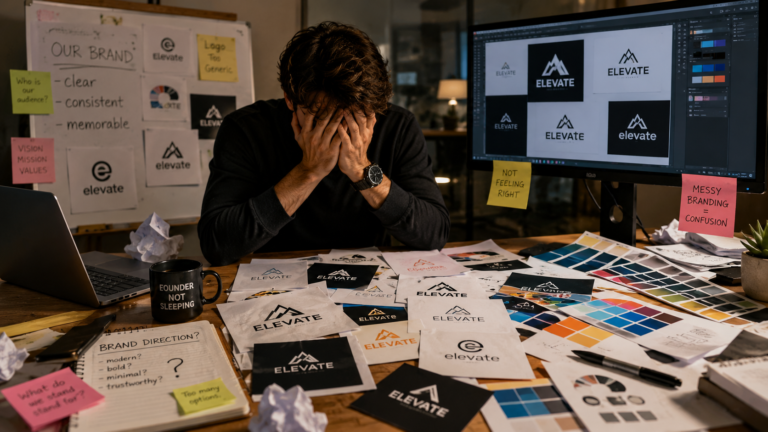
Without brand guidelines, every contractor and team member interprets your brand differently. Six months in, you have four versions of your logo in circulation and nobody knows which is correct.
Without brand voice guidelines, your website sounds like a corporate manual while your Instagram sounds like a personal account. The disconnect makes your business feel disorganised.
The cumulative effect of all this is that your business looks smaller, less trustworthy, and less professional than it actually is — regardless of how good your product or service truly is.
Brand Identity vs Logo Design — They Are Not the Same
This is the most common misconception in branding. Many startups invest in a logo and believe they have a brand identity. They do not.
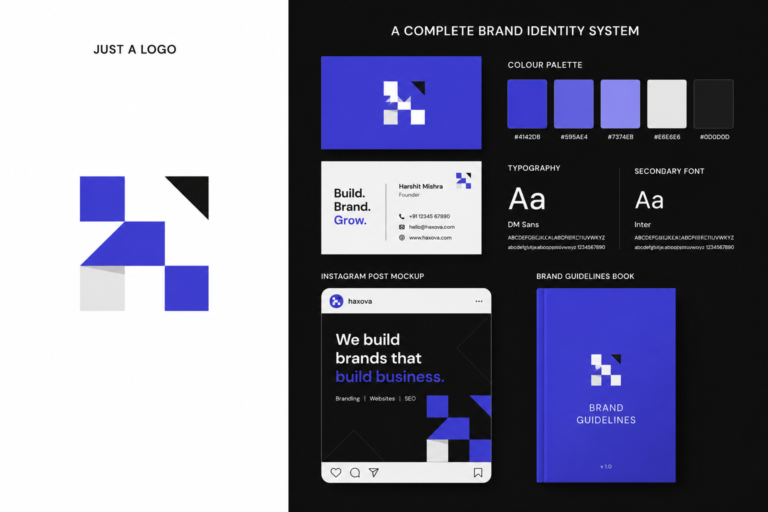
A logo is one element. Brand identity is the complete system that includes the logo, colours, typography, guidelines, voice, and supporting visuals — all working together from the same strategic foundation.
Getting a logo without a full brand identity is like buying a front door without building the rest of the house. The door might look excellent. But it does not function without the structure around it.
Read the full breakdown: Logo Design vs Brand Identity — What is the Difference?
When Should a Startup Build Its Brand Identity?
The honest answer is before you go to market — or at the very least, before you start spending money on marketing.
Here is why. Every rupee you spend on advertising a brand that does not look credible is partially wasted. A well-targeted ad campaign pointing to a weak website with an inconsistent brand converts at a fraction of the rate of the same campaign pointing to a polished, trustworthy brand.
Build your brand identity before your website goes live, before your social media accounts get active, and before your first marketing campaign runs. This is not about perfection — it is about having a consistent foundation to build everything else on.
If you have already launched without a proper brand identity, the second-best time to build one is right now. Every day you operate with an inconsistent brand is a day you are leaving credibility — and customers — on the table.
See how Haxova builds brand identities for startups across India
How Much Does Brand Identity Design Cost in India?
Costs vary widely depending on scope and agency. Here is a realistic breakdown for startups in India.
A logo-only project typically costs between Rs 10,000 and Rs 30,000. This gives you a logo but not a complete identity system.
A complete brand identity project — logo system, colour palette, typography, brand guidelines, and social media kit — typically costs between Rs 50,000 and Rs 2,00,000 depending on the agency and scope.
Full brand strategy plus identity, which includes positioning workshops, competitor research, and messaging before design begins, typically starts from Rs 1,50,000 and goes higher.
For most early-stage startups, a complete brand identity in the Rs 50,000 to Rs 1,00,000 range delivers the best combination of quality and value. This is a one-time investment that pays returns across every piece of marketing you ever run.
Read: How Much Does Branding Cost in India? Full 2026 Pricing Guide
How Haxova Approaches Brand Identity Design
At Haxova, every brand identity project begins with a discovery session — not a design brief. We need to understand your business, your customers, your competitors, and your market before a single design decision is made.
Once the strategy is clear, we build a complete brand identity system: logo variations, colour palette with all colour codes, typography system, brand guidelines document, and a social media kit.
We work entirely online and serve startups and small businesses across Delhi, Mumbai, Bangalore, Hyderabad, Pune, Kanpur, and the rest of India.
Ready to build your brand identity? Talk to the Haxova team
Also read: The Complete Branding Guide for Startups in India
Frequently Asked Questions
What is brand identity in simple terms?
Brand identity is the collection of visual and verbal elements that make your business look and sound consistent everywhere — your logo, colours, typography, brand guidelines, and tone of voice. It is how customers recognise and remember your business across every platform and interaction.
What is the difference between brand and brand identity?
Your brand is the perception people have of your business — the trust, the emotion, the reputation. Your brand identity is how you express that perception visually and verbally through logos, colours, typography, and voice. Think of your brand as your character and your brand identity as how you present yourself.
What should a brand identity include?
A complete brand identity includes a logo system with multiple variations, a colour palette with exact colour codes, a typography system with heading and body fonts, brand guidelines documenting how everything should be used, a brand voice guide, and a social media kit. A logo alone is not a brand identity.
Why is brand identity important for startups?
Startups do not have years of reputation to rely on. Brand identity is what makes a new business look credible and trustworthy to customers who have never heard of you before. It also makes every marketing channel more effective, justifies premium pricing, and attracts the right customers.
How long does it take to create a brand identity?
A complete brand identity project typically takes three to five weeks from discovery to final delivery. This includes brand strategy, design concepts, revision rounds, and final file delivery. Rushing the process is one of the most common reasons founders end up with a brand they want to redo six months later.

Hi there,
With the new semester approaching, the cost of course materials can add up quickly.
At ReadWisely, we focus on making academic success more accessible by providing textbooks at significantly reduced prices. Whether you are looking to save on required reading or want to avoid the high costs of campus bookstores, you can find affordable options for your courses here: ReadWisely.com
Feel free to browse our collection and see how much you can save on your materials this term.
Best regards,
The ReadWisely Team
ReadWisely.com
[Timestamp: 2026-06-20 23:31:18]