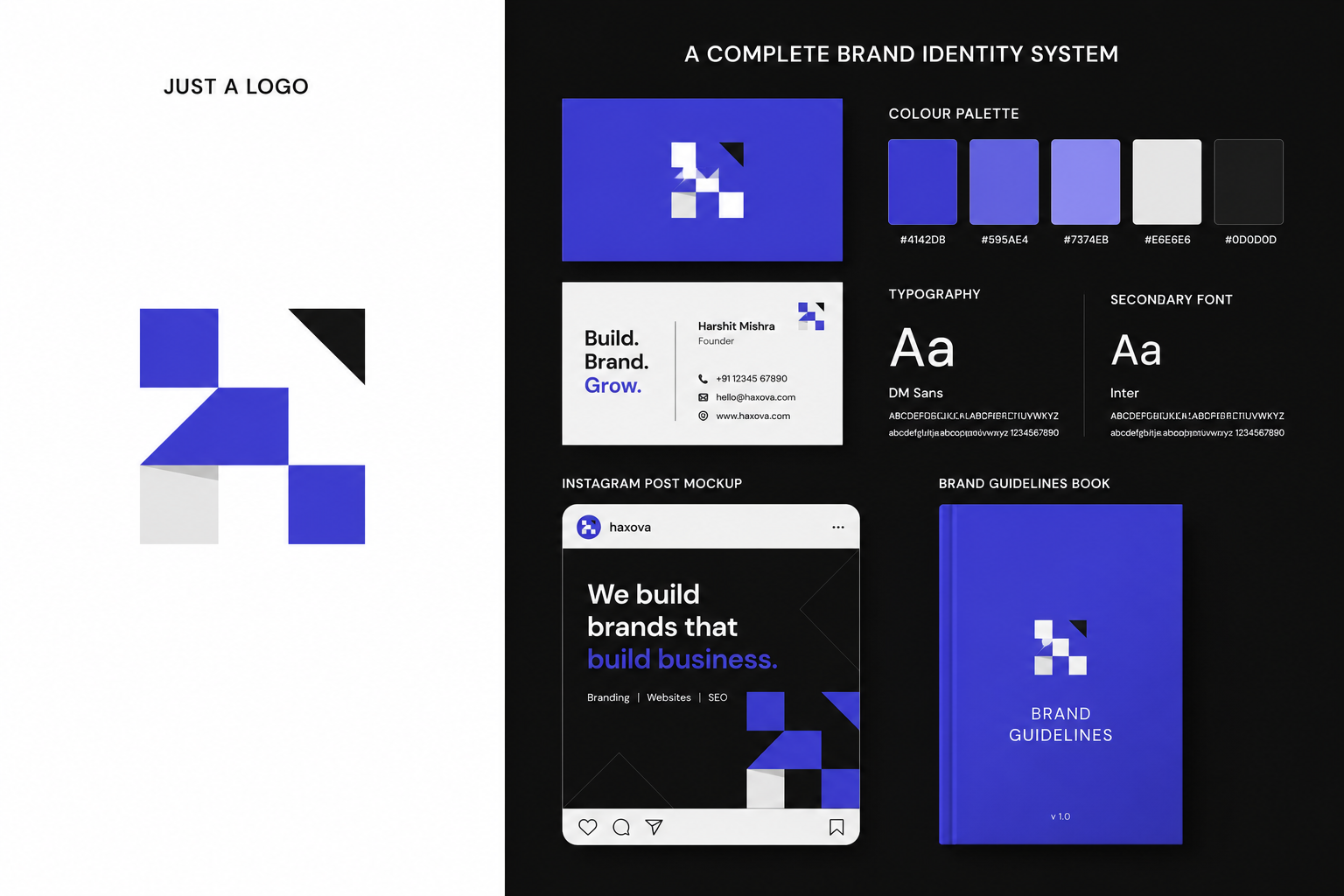
Logo Design vs Brand Identity: What is the Difference?

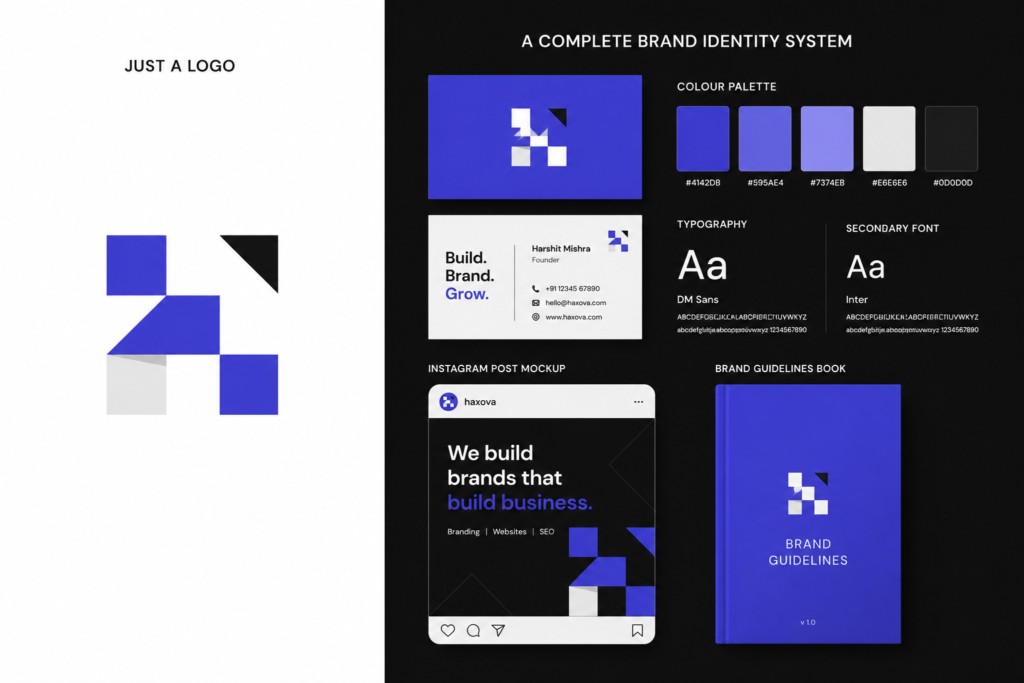
Ask ten startup founders what branding means and nine of them will point at their logo.
That is the most expensive misunderstanding in early-stage business. Because the logo is one piece. Brand identity is the entire puzzle.
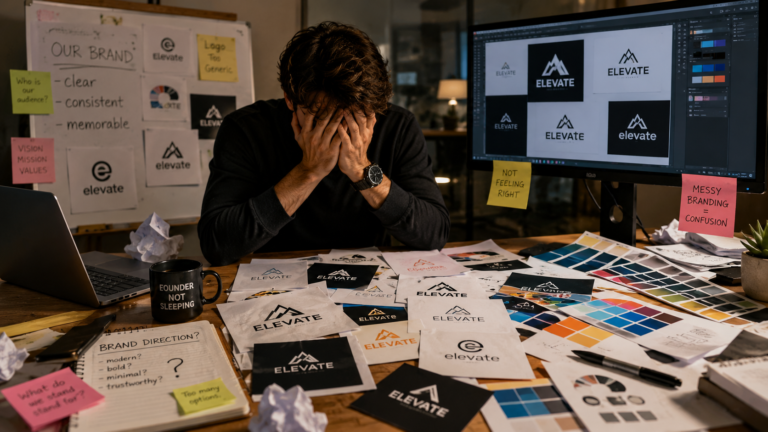
Confusing the two does not just leave gaps in your visual presence — it leads to real business problems. Inconsistent marketing. Lower conversion rates. A brand that looks different across every platform. And eventually, money spent redoing work that should have been done right the first time.
This guide explains exactly what logo design is, what brand identity is, how the two relate, and why the difference matters more than most founders realise.
What is Logo Design?
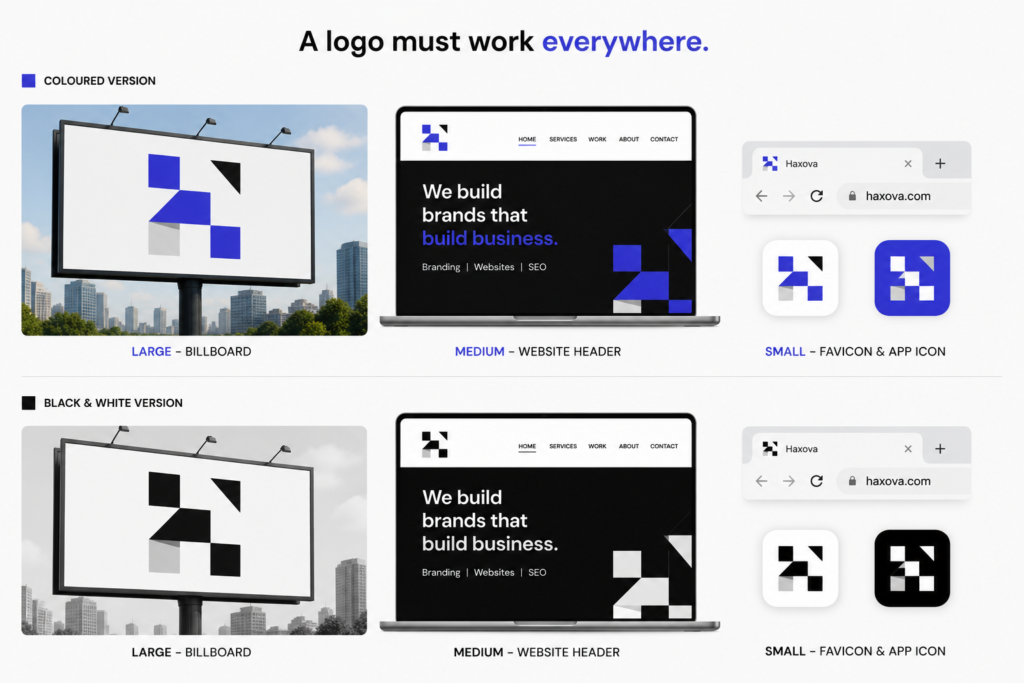
A logo is a visual mark that represents your business. It is the symbol, wordmark, or combination of both that identifies your company at a glance.
A well-designed logo is clean, memorable, and versatile — meaning it works in colour and black and white, at large sizes and small sizes, on screen and in print.
What a logo does: — Identifies your business visually — Creates immediate recognition — Acts as the anchor for your brand’s visual presence
What a logo does not do: — Tell your brand story — Define how your business communicates — Ensure consistency across platforms — Build trust on its own
A logo is a symbol. It is not a strategy. And without the system around it, even the most beautifully designed logo falls short of doing what a brand actually needs to do.
What is Brand Identity?
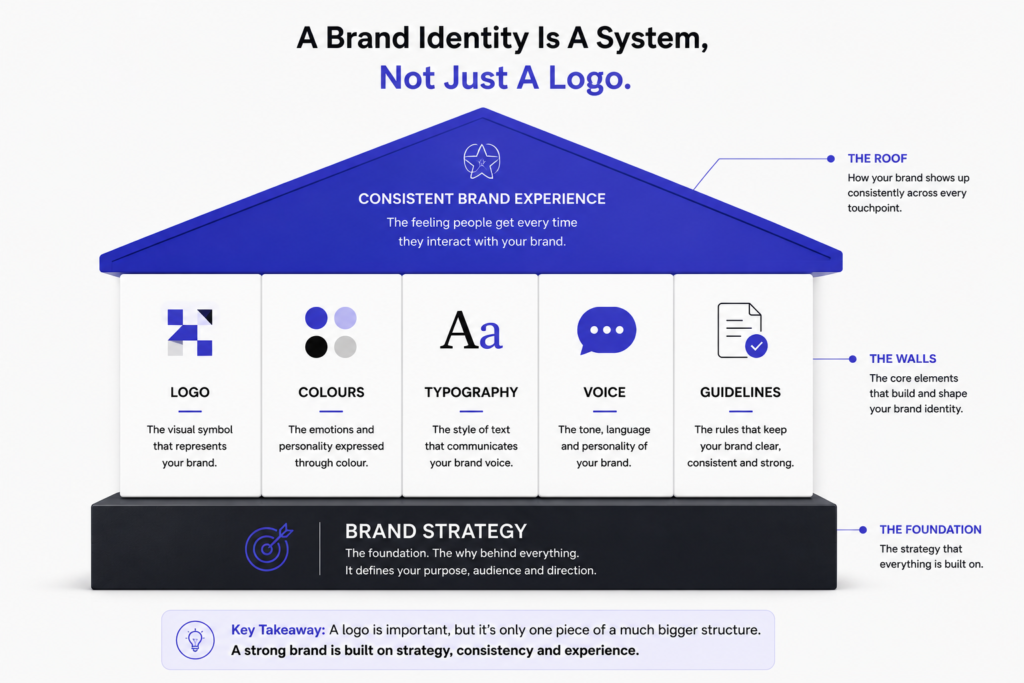
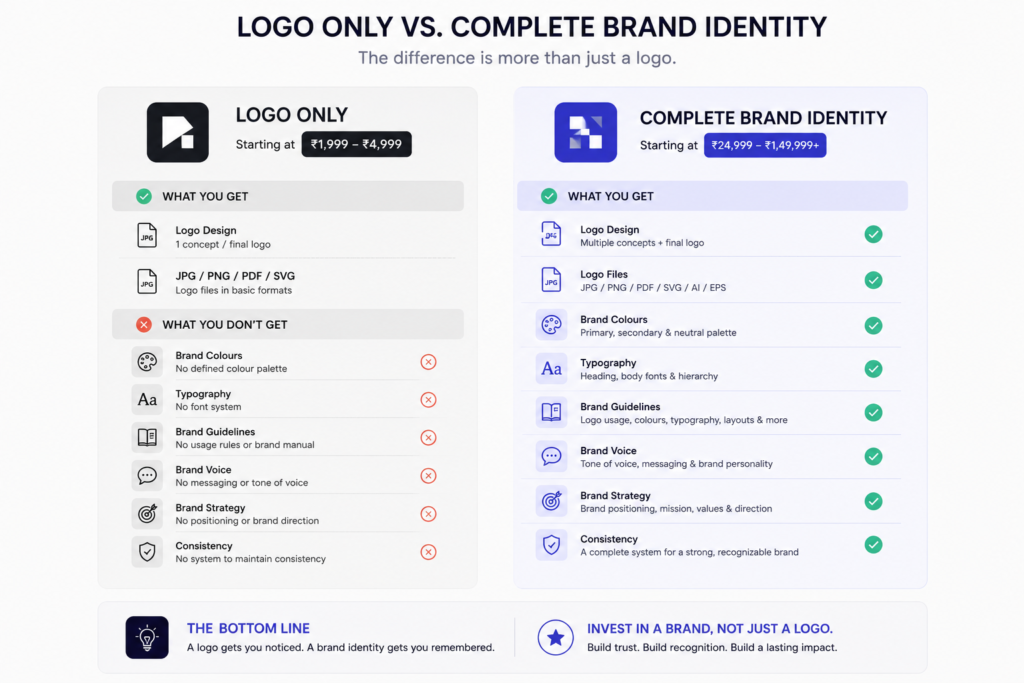
Brand identity is the complete system of visual and verbal elements that make your business recognisable and consistent everywhere it appears.
It includes your logo — but it goes significantly further.
A complete brand identity includes:
Logo System — your primary logo, alternate logo, standalone icon, and wordmark, each designed for different contexts and sizes.
Colour Palette — your primary brand colour, secondary colours, neutral tones, and accent colour — each with exact HEX, RGB, and CMYK codes so your brand reproduces consistently in every medium.
Typography — a heading font and a body font that work together and communicate your brand personality through every piece of text.
Brand Guidelines — the rulebook that tells anyone who works with your brand exactly how to use every element correctly — spacing, colour rules, what to do and what never to do.
Brand Voice — how your brand communicates in words. The personality and tone that comes through in your website copy, social media captions, emails, and every piece of written communication.
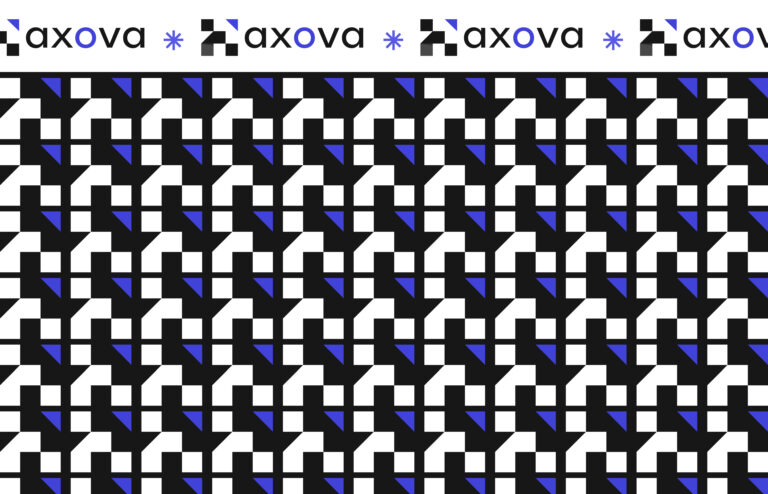
Supporting Visuals — photography style, illustration approach, icon style, and any recurring visual patterns that make your brand recognisable even without the logo present.
When all of these elements are built from the same strategic foundation and follow the same rules, your brand feels consistent, professional, and trustworthy — across your website, your social media, your packaging, your proposals, and every other touchpoint.
Read the full breakdown of every brand identity component
The Core Difference: Mark vs System
The simplest way to understand the difference:
A logo is a mark. Brand identity is a system.
Your logo identifies your business. Your brand identity governs how your business looks, sounds, and feels across every situation.
Think of it this way. A person’s name identifies them. But their identity — how they dress, speak, carry themselves, and present to the world — is what actually makes them recognisable and memorable. You can know someone’s name and have no clear sense of who they are. The same is true for a brand.
A logo without brand identity is a name without a personality.
Here is a concrete example. Two competing agencies both have well-designed logos. One has a complete brand identity system — consistent colours everywhere, a defined typography system, a recognisable visual style on social media, and a brand voice that comes through in every piece of content. The other just has the logo.
Customers will consistently perceive the first agency as more professional, more established, and more trustworthy — even if the underlying service quality is identical.
Why Most Startups Only Get a Logo (And Why That Hurts Them)
Logo-only projects are popular for one reason: they cost less upfront.
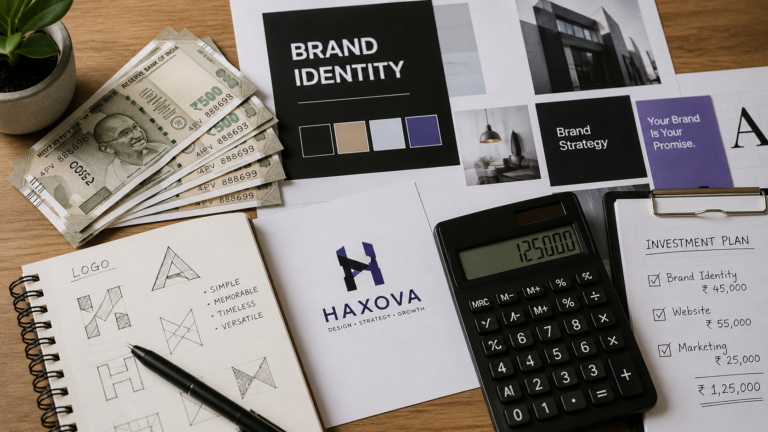
A logo from a freelancer or a platform like Fiverr or 99designs can cost anywhere from Rs 2,000 to Rs 20,000. A complete brand identity from a professional agency costs Rs 50,000 to Rs 2,00,000 or more. The gap feels large when you are watching every rupee at the start.
But the actual cost calculation looks different when you factor in what happens next.
Without a colour palette, every new piece of marketing content becomes a guessing game. Your social media posts look different from your website. Your presentations look different from your proposals.
Without typography guidelines, your brand uses whatever font whoever is working on your content happens to prefer that day. Over time, your business accumulates four or five different “looks” with no coherent identity tying them together.
Without brand voice guidelines, your website sounds like a formal corporate document while your Instagram sounds like a personal account. Customers who encounter both cannot reconcile them into a single, trustworthy brand.
The cost of fixing all of this later — redoing visuals, recreating templates, retraining team members, and reestablishing brand recognition — almost always exceeds the cost of doing it right the first time.
Do You Need Just a Logo or a Full Brand Identity?
The honest answer depends on where you are in your business journey.
You might be fine with just a logo if you are pre-revenue and genuinely testing a business idea before committing fully, if you are building a quick prototype or MVP and brand is not a priority yet, or if you have strong design skills yourself and can build the rest of the system later.
You need a full brand identity if you are preparing to launch and will be spending money on marketing, if you are building a website that needs to convert visitors into customers, if you will be pitching investors or approaching enterprise clients, if you are hiring team members or working with contractors who will create content, or if your business operates across multiple platforms and needs to look consistent everywhere.
The rule of thumb is this: once money is being spent on marketing, brand identity is no longer optional. Every rupee spent on advertising a brand that does not look credible is partially wasted. A complete brand identity is what makes marketing actually convert.
What to Ask For When Hiring a Branding Agency
When you are ready to invest in brand identity, knowing what to ask for protects you from paying for incomplete work.
A complete brand identity project should deliver all of the following. A primary logo plus alternate variations and a standalone icon. A full colour palette with HEX, RGB, and CMYK codes for every colour. A typography system specifying heading and body fonts with usage rules. A brand guidelines document covering all usage rules, do’s and don’ts, and examples. A social media kit with profile picture and cover photo templates for your main platforms. And optionally, a brand voice guide defining tone, style, and messaging.
If an agency proposes to deliver only a logo file and calls it “complete branding” — that is not a complete project. Be clear about what you need before signing anything.
See how Haxova builds complete brand identities for startups
Also read: How Much Does Branding Cost in India? Full 2026 Pricing Guide
The Bottom Line
A logo is the starting point. Brand identity is the destination.
Your logo gets you recognised. Your brand identity is what makes people trust you, remember you, and choose you. For a startup going to market with limited time and budget, investing in a complete brand identity from the beginning is almost always the smarter financial decision — because it makes everything that comes after it work better.
Read the complete guide: The Complete Branding Guide for Startups in India
Ready to build your brand identity the right way? Talk to Haxova
Frequently Asked Questions
Is a logo the same as brand identity?
No. A logo is one element — a visual mark that identifies your business. Brand identity is the complete system that includes your logo, colour palette, typography, brand guidelines, brand voice, and supporting visuals. A logo without brand identity is like a name without a personality.
Can I have a brand identity without a logo?
Technically yes — some brands use strong typography or colour as their primary identifier. But in practice, almost every business needs a logo as the anchor of its brand identity. The question is never logo or brand identity — it is always logo as part of brand identity.
How much more does brand identity cost compared to just a logo?
A logo alone might cost Rs 10,000 to Rs 30,000. A complete brand identity typically costs Rs 50,000 to Rs 2,00,000 depending on scope and agency. The difference looks large upfront but is significantly smaller when you factor in the cost of inconsistency, rework, and underperforming marketing that comes with having only a logo.
What happens if I launch with just a logo?
You will likely see inconsistency across your platforms, weaker marketing performance, and a brand that looks less professional than it could. At some point, most startups end up investing in a full brand identity anyway — but at a higher cost because existing inconsistencies need to be corrected first.
Should I get a logo or brand identity first?
Get your brand identity built — with the logo as part of it. They should be built together from the same strategic foundation, not separately. A logo designed without the rest of the brand identity system in mind often needs to be revised anyway when the full system is built later.